 listicle
Full Service Event Setup Benefits: 7 Wins for Hosts
Table of Contents
- What Full Service Event Setup Actually Covers
- 7 Full Service Event Setup Benefits That Change Your Event Day
- Event Setup and Teardown Services: What Happens Before and After
- Event Layout Planning: Getting the Room Right the First Time
- DIY Event Setup vs. Full Service: A Side-by-Side Look
- Corporate Event Planning Checklist: Where Setup Fits In
- Frequently Asked Questions
Last Updated: October 5, 2026
What Full Service Event Setup Actually Covers
Full service event setup means a rental provider delivers, places, styles, and later removes every piece of event equipment for you, so you never touch a folding table on your event day. At Special Event Depot, we've handled this for backyard weddings, company picnics, and school fundraisers across North Texas, and hosts who book full service event setup spend their event day with guests instead of wrestling chair stacks.
Delivery, Placement, and Styling
Delivery day starts with a truck arriving at your venue, not a pile of equipment dumped at the curb. The crew unloads, carries everything to the exact spot you mapped out, and assembles what needs assembling.
- Tents raised, staked, and squared to your layout
- Tables and chairs placed by section: dining, gift, sign-in, buffet
- Linens draped and adjusted on site
Placement is the hard part, not delivery. Moving forty chairs twice because the buffet line blocks the cake table eats an hour.
Teardown and Post-Event Pickup
Teardown is where DIY hosts pay the real price. After a four-hour event, someone still has to break down tables, stack chairs, bag linens, and haul it all to a pickup point.
With full service, the crew returns on a scheduled window, disassembles everything, loads the truck, and leaves your venue as they found it. You sign off, and you're done, no Monday morning truck rental, no borrowed trailer in the driveway for a week.
7 Full Service Event Setup Benefits That Change Your Event Day
- Time savings. You skip the pickup, the hauling, the setup, and the teardown. That's most of a day back on both ends of your event.
- Reduced stress. No loading a truck the morning of your party while guests are already texting for directions.
- Better guest experience. Equipment is placed correctly the first time, so lines move and seating works.
- Professional atmosphere. Matched tables, straight lines, and clean equipment read as intentional.
- Fewer injuries. Crews move heavy tables and raise tents. Your uncle's back stays intact.
- Flexibility. Larger guest counts, added tents, or extra serving stations get handled without a second trip.
- One point of contact. Delivery, setup, and teardown all run through the same provider instead of three phone numbers.
Time Savings and Reduced Stress
The average host underestimates setup by hours, not minutes. A backyard wedding with 150 guests can involve dozens of tables, hundreds of chairs, linens, a tent, and a serving setup. Doing that yourself means recruiting family members and starting at dawn.
Full service compresses that into a crew arriving on a schedule you agreed to in advance. You point, they place, the difference between hosting and working.
Guest Experience and Professional Atmosphere
Guests notice layout before anything else. A room where the buffet line crosses the dance floor feels cramped even when it isn't, and professional placement fixes that before anyone walks in.
Uniform tables, straight rows, and clean equipment set a tone. For corporate events, that tone is the whole point: client appreciation parties and product launches are judged on presentation within the first minute.
Event Setup and Teardown Services: What Happens Before and After
Event setup and teardown services cover the full arc of your rental: delivery and placement before the event, then breakdown and removal after it, so the equipment is never your problem, only your guests' backdrop.
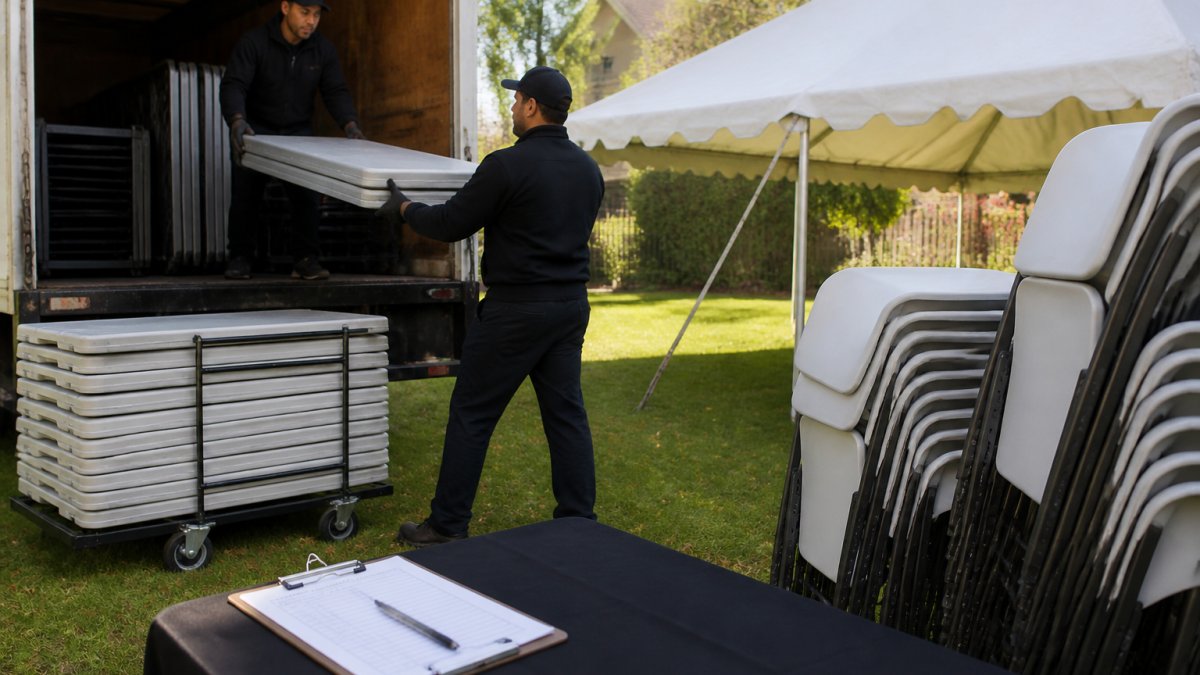
Here's how a typical timeline runs for a Saturday afternoon event:
| Phase | Timing | What Happens |
|---|---|---|
| Confirm layout | 1-2 weeks out | Share guest count, venue access, and a sketch |
| Delivery and setup | Morning of event | Crew places, assembles, and styles everything |
| Host walkthrough | 30 minutes before | You check placement and flag adjustments |
| Teardown | Same evening or next morning | Crew breaks down, loads, and clears the site |
The teardown window matters more than people expect. Ask whether same-night pickup is included or equipment stays overnight, because that answer changes your venue access plan.
Event Layout Planning: Getting the Room Right the First Time
Event layout planning decides whether your space feels generous or cramped, and it happens long before any truck arrives. Start with your event objectives: a networking reception wants open floor and tall tables, a seated dinner wants defined rows with clear aisles, and a company picnic wants zones for food, games, shade, and seating.
Then work the numbers:
- Allow roughly 10 square feet per person for standing receptions
- Plan wider aisles than you think you need for buffet and bar lines
- Keep the cake, gifts, and photo area out of traffic paths
Accessibility and safety checks belong in this step, not the day of. If your venue has a step, slope, or narrow gate, flag it when you book so the crew brings the right equipment and enough people.
Setup Timeline: From Walkthrough to Teardown
A realistic timeline prevents last-minute scrambles. Here's a typical Saturday event schedule:
| Phase | Timing | Key Actions |
|---|---|---|
| Venue walkthrough | 4-6 weeks out | Measure spaces, note access points, photograph outlets and obstacles |
| Floor-plan approval | 2-3 weeks out | Submit sketch to provider; confirm tent, table, and stage placements |
| Final headcount and layout lock | 1 week out | Confirm guest count, catering setup, AV needs; no major changes after this |
| Delivery and setup | Morning of event | Crew places, assembles, and styles per approved plan |
| Host walkthrough | 30-60 minutes before | Check placement, flag adjustments, sign off |
| Event-day checks | During event | Monitor crowd flow, refill supplies, address spills |
| Teardown | Same evening or next morning | Crew breaks down, loads, and clears site |
This assumes a single-day event; for multi-day events, add a day for reset between sessions.
Responsibility Matrix: Who Handles What
Confusion over responsibilities causes most setup failures. Use this matrix to clarify roles before booking.
| Task | Typically Provider | Typically Host | Notes |
|---|---|---|---|
| Furniture delivery and placement | ✓ | Confirm exact spots with tape or diagram | |
| Tent setup and staking | ✓ | Host must mark underground utilities | |
| Linens and décor styling | ✓ | Host may supply custom items | |
| AV installation | ✓ | Host provides equipment or hires separate AV vendor | |
| Catering setup | ✓ | Provider may place tables; caterer handles food and chafing | |
| Permits and insurance | ✓ | Check local requirements; provider may require certificate | |
| Signage and wayfinding | ✓ | Host supplies signs; crew places them | |
| Teardown and cleanup | ✓ | Confirm trash removal and site clearance | |
| Last-minute changes | ✓ | Discuss change fees and cutoffs in advance |
This matrix prevents the common gap where a host assumes the provider handles catering setup, or the provider assumes the host will move tables for the caterer.
Measuring Success: Metrics That Matter
After the event, assess setup quality with these metrics:
- Budget variance: Compare final invoice to quote. A variance under 5% indicates accurate scoping.
- Setup-time reliability: Did the crew finish within the agreed window? Track start and finish times.
- Attendee satisfaction: Survey guests on layout, comfort, and flow, especially lines and seating.
DIY Event Setup vs. Full Service: A Side-by-Side Look
DIY event setup vs. full service is really a question about where you want to spend your energy. DIY saves on the service line and costs you a day of labor, a truck rental, and a crew of willing relatives.
| Factor | DIY Setup | Full Service Setup |
|---|---|---|
| Your time on event day | 4-8 hours | Under an hour |
| Truck and hauling | You arrange it | Included in delivery |
| Help needed | Family and friends | Professional crew |
| Placement accuracy | Trial and error | Planned in advance |
| Teardown | Same night, tired | Scheduled pickup |
| Damage handling | You're on the hook | Clarified in the agreement |
| Setup time reliability | Variable | Contracted window |
| Access to commercial-grade equipment | Limited to rentals | Included in package |
DIY works fine for a small gathering: one table, a dozen chairs, a cooler. Past roughly 50 guests, the math tilts hard toward full service, mostly because teardown at 10 p.m. after hosting all day is brutal.
Cost Breakdown: What You're Actually Paying For
Full-service pricing typically includes several components. Understanding them helps you compare quotes and avoid surprises.
- Package or base fee: Covers delivery, standard setup, and teardown for a defined inventory (e.g., tables, chairs, linens, tent).
- Labor: Crew size and hours. Larger events or complex layouts require more labor.
- Rentals: Furniture, tents, AV, staging, and décor. Often itemized separately.
DIY costs include truck rental, fuel, equipment rentals, and your time. If you value your time at a reasonable hourly rate, the DIY savings shrink quickly. For a 150-guest event, the labor alone can exceed the service fee.
Measuring ROI: Beyond the Invoice
Full service isn't just a line item; it's an investment in outcomes. Track these metrics:
- Setup-time reliability: Did the crew finish within the agreed window? Late setup can delay catering and guest arrival.
- Budget variance: Compare final cost to initial quote. A variance under 5% indicates accurate scoping.
- Attendee satisfaction: Survey guests on layout, comfort, and flow. Higher satisfaction correlates with professional placement.
Full service typically pays for itself when guest count exceeds 50, or when the event is high-stakes (corporate, wedding, fundraiser). The break-even point isn't about money alone; it's about risk and experience.
Corporate Event Planning Checklist: Where Setup Fits In
A corporate event planning checklist keeps setup from becoming an afterthought. Work backward from your event date and slot setup into the plan early.
- 8-12 weeks out: Set event objectives, guest count, and budget
- 6-8 weeks out: Book venue and confirm access times, including load-in
- 4-6 weeks out: Reserve rentals and confirm delivery window
Catering logistics deserve their own line. Serving tables, chafing setups, and trash stations need placement decisions, and they interact with your room layout more than any other element.
Questions to Ask Any Setup Provider Before Booking
Ask these before you sign anything. The answers tell you more than any website photo.
- What's included in the quoted total? Get delivery, setup, teardown, and any service fees itemized in writing so there are no surprise charges later.
- How is damage handled? Ask for the damage policy in plain language before your event, not after.
- How far out do you book? Availability tightens in peak seasons, so confirm your date early.
At Special Event Depot, we deliver commercial-grade, sanitized equipment straight to your venue or home, with tailored bundles for large events and flexible configurations whether you're seating 30 or 300. Our team handles the heavy lifting so your setup is seamless from delivery to pickup.
Frequently Asked Questions
What does full service event setup include?
Full service event setup covers delivery, placement, and assembly of your rented items, plus teardown and pickup once the event ends. That typically means tables, chairs, tents, linens, and any games or staging equipment you booked. A crew positions everything according to your event layout plan, tests the setup, and returns after the event to break it down. You are not responsible for hauling anything, and you do not need to be on site for teardown.
How does professional event setup save planning time?
When you handle setup yourself, you lose hours to pickup, transport, assembly, and return trips. Professional event setup and teardown services compress that into a scheduled window on event day. You spend your time on guest lists, catering arrangements, and vendor management instead of moving furniture. For a 150-guest event, that can free up most of a full day you would otherwise spend on logistics.
How far in advance should I book full service event setup?
Three to four weeks is a comfortable window for most events, and six to eight weeks is safer for weddings and large corporate gatherings during peak season. Three weeks out is often still workable, especially for standard items like tables, chairs, and tents, but availability tightens as the date approaches. Book as soon as your date and guest count are firm.
What should I ask an event setup provider before booking?
Ask what the quote includes: delivery, setup labor, teardown, and any service fees. Confirm the cancellation policy and whether a damage waiver is offered. Ask how the crew handles layout changes on site and what happens if an item arrives damaged. Finally, request the real total upfront so no surprise charges appear after the event. A provider that answers these clearly is usually easier to work with.
The hard part of hosting isn't the guest list or the menu. It's the hundred small physical tasks between an empty yard and a finished event space, and they all land on the same day. Special Event Depot takes that entire load off your plate with commercial-grade, sanitized tables, chairs, tents, and yard games delivered and placed at your venue, plus tailored bundles that scale to your guest count. Reserve now and spend your event day with your guests instead of a stack of folding chairs.