 blog
blog
Backyard Event Rental Essentials for Summer Parties
Table of Contents
- Backyard Event Rental Essentials for Summer Parties: What to Book First
- Start With Shade and Seating
- How to Keep a Party Tent Cool in Summer
- Backyard Party Tent Rental Guide: Sizing, Placement, and Permits
- Best Outdoor Games for Summer Parties
- Logistics and Rental Coordination: Delivery, Setup, and Timelines
- Weather Contingency Planning for Backyard Events
- Sustainability and Accessibility: Two Things Most Rental Guides Skip
- Conclusion: Reserve Early, Confirm the Details, Enjoy the Party
- Frequently Asked Questions
Last Updated: October 4, 2026
Backyard Event Rental Essentials for Summer Parties: What to Book First
Booking backyard event rental essentials for summer parties starts with shade and seating, then works outward to cooling, games, and logistics. This guide from Special Event Depot covers what to reserve, in what order, and how to avoid gaps.
Shade and seating sell out first every summer, and they're the two you can't improvise. A tent without enough chairs is a sun shelter with nowhere to sit; chairs without shade become unusable by early afternoon.
Start With Shade and Seating
Shade and seating come first because everything else depends on them. Once you know your tent footprint and guest count, the rest becomes a checklist:
- Tent or shade structure, sized to your guest count and yard dimensions
- Tables and chairs, one seat per guest, plus a few extras
- Cooling equipment, fans, sidewalls, and airflow planning
- Food and beverage stations, serving trays, drink dispensers, chilled condiment trays, warming dishes
- Games and entertainment, lawn games, activity stations
- Decor accents, lighting zones, table linens, signage
A common mistake is booking decor before confirming seating. Guests remember whether they had a chair and were comfortable; they rarely remember the centerpieces.
How to Keep a Party Tent Cool in Summer
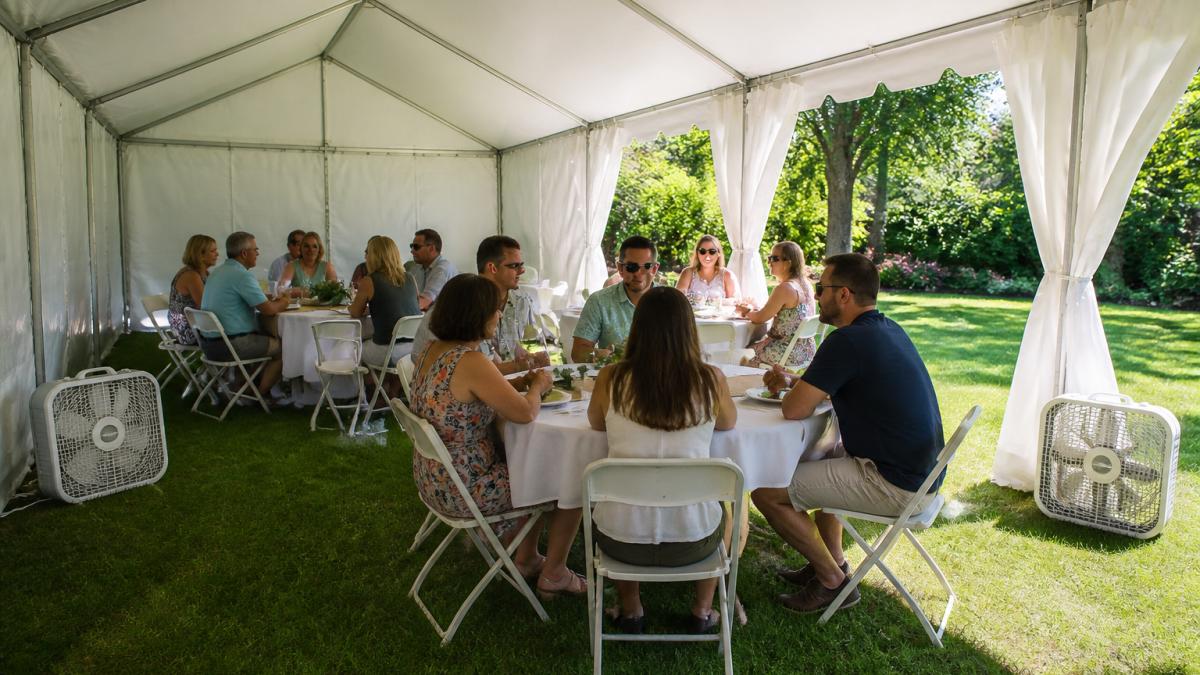
A party tent stays cool when air moves through it. Block the sun on the sunny side, open the shaded side, and aim fans across the seating area rather than into a wall.
The most common mistake is sealing a tent completely with sidewalls, which traps heat and turns it into an oven by mid-afternoon. Sidewalls belong on the sun-facing sides only.
Fan Placement and Sidewall Strategy
Place box fans at the tent corners, angled to push air diagonally. Two fans at opposite corners create a cross-breeze that covers more seating than four fans pointed the same way.
Sidewall strategy depends on the time of day:
- Morning events: Open everything. The sun is low and shade is easy.
- Midday events: Close sidewalls on the south and west sides, open the rest.
- Evening events: Reverse it. Close the west side as the sun drops, open the east.
If your event runs past sunset, plan lighting zones inside the tent before dark. Guests gravitate toward whatever is lit, so use that to control traffic flow.
Backyard Party Tent Rental Guide: Sizing, Placement, and Permits
A backyard party tent rental guide starts with one number: square feet per guest. Plan 10 to 15 square feet per person for seated dining, and 6 to 8 for standing cocktail-style events.
How Much Space Do You Actually Need?
Match your tent size to your guest count and event style:
| Event Style | Space Per Guest | 50 Guests | 100 Guests |
|---|---|---|---|
| Seated dinner | 10-15 sq ft | 500-750 sq ft | 1,000-1,500 sq ft |
| Cocktail standing | 6-8 sq ft | 300-400 sq ft | 600-800 sq ft |
| Ceremony seating | 8-10 sq ft | 400-500 sq ft | 800-1,000 sq ft |
| Mixed seating and buffet | 12-15 sq ft | 600-750 sq ft | 1,200-1,500 sq ft |
Placement matters as much as size. Leave at least 3 feet between the tent edge and any fence, with roughly 2 feet beyond the perimeter for stake lines. Tell your provider about irrigation lines or buried utilities before delivery day. Permit requirements vary by city and tent size, so check with your local permitting office before you book.
Best Outdoor Games for Summer Parties
The best outdoor games for summer parties work for mixed ages, need no referee, and survive a backyard surface: bean-bag toss, ladder toss, giant Jenga, ring toss, and bocce. The rental-specific question most guides skip is which to rent versus buy, and how to build a rotation that keeps guests moving.
Rent vs. Buy: A Simple Rule
Rent games that are bulky, heavy, or used once a year. Buy games that are small, cheap, and get pulled out on ordinary weekends.
- Rent: Giant Jenga, oversized Connect Four, cornhole boards with weighted bases, bocce sets, giant yard dice, ring-toss stands, and any inflatable. These are the items that eat garage space and cost more than people expect to replace.
- Buy: A standard deck of cards, a frisbee, sidewalk chalk, and a basic horseshoe set. These cost little and store flat.
Providers typically deliver games with tables and chairs, so there's no separate trip or assembly. Confirm whether they supply the game pieces, carrying case, and setup.
Build a Rotation, Not a Pile
A common pattern is setting out six games and watching guests play two. The fix is a rotation with a clear flow:
- Arrival game (low effort, no skill): cornhole or ring toss near the entrance. Gives early guests something to do while they wait.
- Mid-party game (team-based): ladder toss or bocce. Pulls people into pairs and small groups.
- Late-party game (novelty): giant Jenga or oversized Connect Four. Works after dinner when energy dips and people want to sit or lean.
Space stations 10 to 12 feet apart so a stray bean bag or bocce ball doesn't land in another game. Put the arrival game near the drinks and the late-party game near the seating so guests drift between them.
Surface and Safety Checks
- Grass: Works for cornhole, ladder toss, bocce, and giant Jenga. Bocce needs a relatively flat run; a sloped lawn turns every roll into a chase.
- Patio or deck: Works for ring toss and giant Jenga. Skip bocce and horseshoes, which need soft ground and clear space.
- Bare dirt or gravel: Avoid. Balls bounce unpredictably and pieces get lost.
Keep game stations out of the main path between the house, food, and restroom. A cornhole board in the traffic lane becomes a trip hazard after dark.
Age-Mix Strategy
For events with toddlers through grandparents, run two tracks: low-motion (ring toss, giant Jenga, cornhole from a seated position) and active (ladder toss, bocce). Skip small pieces with young children and bending or kneeling games with older guests. A cornhole board on a table-height platform lets seated guests play without getting up.
Logistics and Rental Coordination: Delivery, Setup, and Timelines
Delivery timing makes or breaks event day. Most providers deliver the day before or the morning of, with pickup the next business day. Confirm both windows in writing before paying a deposit.
Here's a realistic timeline for a Saturday afternoon event:
- 3-4 weeks out: Reserve tents, tables, chairs, and any specialty items
- 2 weeks out: Confirm final guest count and adjust the order
- 1 week out: Confirm delivery window, setup time, and pickup window
Ask two questions before booking: who sets up the equipment, and who is responsible for damage during the event. Setup policies and damage terms vary, so get answers in writing.
Weather Contingency Planning for Backyard Events
Every outdoor event needs a weather plan, even in a dry summer month. It doesn't need to be elaborate, just decided before the day arrives.
Build your contingency around three thresholds:
- Light rain: Sidewalls go up, games move under the tent or inside, food stations get covered.
- Heavy rain or wind: Move the event inside or to a covered structure. Tents should come down in high wind for safety.
- Extreme heat: Shift the schedule later in the day, add a second cooling station, and increase water and shade.
Secure anything lightweight before guests arrive. Paper goods, linens, and lightweight decor become projectiles in a gust. Tent weights or stakes belong in your rental order, not as an afterthought.
Sustainability and Accessibility: Two Things Most Rental Guides Skip
Most rental guides stop at decor and games. Two topics they miss are sustainability and accessibility, and both are easier to handle at booking than on event day.
Sustainability: Rental Is a Start, Not a Guarantee
Renting is less wasteful than buying disposable party supplies, but the choice isn't automatic. Reusable dinnerware, real glassware, and cloth linens replace hundreds of single-use plates, cups, and napkins headed for the trash, less waste at the curb and less money spent on items used once.
A few concrete ways to push a rental order further toward low-waste:
- Choose reusable over disposable for everything guests touch. Plates, cups, utensils, napkins, and table linens. Cloth napkins and real glassware are standard rental items, not upgrades.
- Skip single-serve packaging. A beverage dispenser and stack of glasses beats a cooler full of canned drinks and a bag of ice. A chilled condiment tray beats individual packets.
- Ask about end-of-life handling. Ask your provider what happens to broken or worn items. A provider that repairs and reuses equipment keeps more out of landfills than one that replaces everything each season.
Accessibility: Plan the Route Before the Layout
A step down to the lawn, a narrow gate, or uneven ground creates real barriers for guests using wheelchairs, walkers, or strollers, and for older guests who need a stable surface. The fix starts with the route, not the decor.
Work through these checks in order:
- Path width. Keep at least one 36-inch-wide path from the house to the seating area. That's the standard width for a wheelchair or walker to pass comfortably, and it also solves most traffic-flow problems you didn't know you had.
- Surface. Place seating on firm, level ground rather than soft grass where possible. A patio, deck, or packed gravel area is more stable than a lawn that's been watered all week.
- Thresholds. A single step between the house and the yard is the most common barrier. A portable ramp or a temporary threshold plate handles it, and many rental providers carry both.
- Seating. Reserve a few chairs with arms for guests who need help standing. Armrests make a real difference for older guests and anyone recovering from an injury.
- Reach. Put food and drink stations within reach of a seated guest, not just standing traffic. A low table beside the seating area works better than a tall cocktail table.
- Lighting. Add lighting along the path for evening events. A dark route is a barrier even when the surface is fine.
Ask Your Provider These Questions
- Do you carry ramps or threshold plates for a single step?
- Can you place seating on the patio instead of the lawn?
- Do your chairs come with arms, and can I specify a mix?
Conclusion: Reserve Early, Confirm the Details, Enjoy the Party
The gap between a smooth backyard party and a stressful one comes down to what was confirmed in advance: delivery windows, setup responsibility, tent sizing, and a weather plan.
Special Event Depot delivers commercial-grade, sanitized tables, chairs, tents, and outdoor games directly to your venue, with flexible configurations for events of any size. Our team handles delivery and setup so you're not moving furniture on the morning of your own party.
Frequently Asked Questions
What equipment do I need to rent for a backyard party?
Start with the essentials: tables, chairs, a tent for shade, and linens. For summer parties, add fans or misting stations, a drink dispenser, and a portable cooling setup. If you plan games, bean-bag toss and ladder ball are easy to set up. Special Event Depot offers bundled packages so you can book everything at once and avoid multiple delivery fees. Confirm your guest count and yard dimensions before ordering to get the right quantities.
How do I keep guests cool at an outdoor summer event?
Shade is your first priority. A tent with at least two sidewalls removed for cross-breeze makes a big difference. Position fans at opposite corners to push air through the space. Serve cold drinks from insulated dispensers and keep water stations in shaded zones. If your event runs midday, schedule activities for morning or late afternoon. For backyard event rental essentials, add a portable cooling unit or misting fan near seating areas where guests linger.
How far in advance should I book backyard party rentals?
For summer weekends, book three to four weeks ahead. Peak dates like holiday weekends and graduation season fill up faster. If your event falls on a Saturday in June or July, four weeks is safer. Three weeks is workable for smaller orders, but tent availability tightens as the date approaches. Special Event Depot recommends reserving as soon as you confirm your guest count and date. Early booking also gives you time to adjust quantities without rush fees.
What are the best outdoor games to rent for summer parties?
Bean-bag toss, ladder ball, giant Jenga, and ring toss work well for mixed-age groups. For larger crowds, add a portable putt-putt or cornhole tournament setup. Water-based games like dunk tanks need a water source and drainage plan. Choose games that suit your yard size and guest mix. Special Event Depot includes complimentary yard activity incentives with qualifying bundles, so ask about game add-ons when you reserve your backyard event rental.